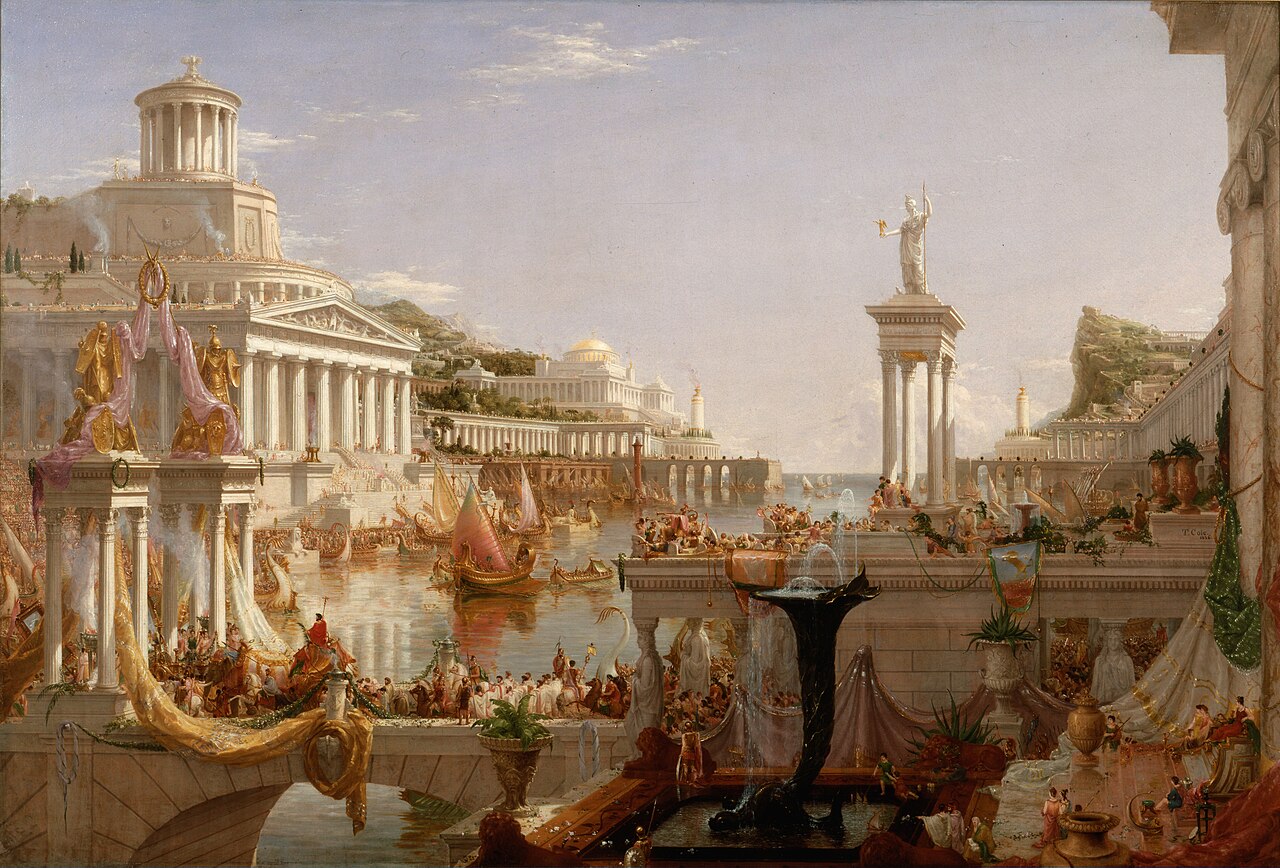
Cole imagines the rise and fall of institutions. The question for stewardship is what might make another future possible.
New York Historical · Public-domain reproductions via Wikimedia Commons
Introduction to the theory
This art project draws on thinkers who identified patterns of institutional growth, inheritance, and decline. Their accounts provide the starting points for exploring the work of stewardship.
The discussion follows a dynasty from founding solidarity through inherited prosperity to the loss of its capacity to sustain itself. Our question is what leadership can do to renew that capacity, rather than treating decline as a fixed timetable.
John Adams
“I must study Politicks and War that my sons may have liberty to study Mathematicks and Philosophy.”
Adams goes on to imagine the grandchildren studying the arts. His hope is that each generation makes a richer life possible for the next. Read cyclically, that hope carries a tension: if successors lose the capacities that secured those freedoms, they may have to learn the earlier generation’s hard lessons again.
Kent Beck
“Applying the approach from one phase to an idea in another phase kills ideas.”
Each phase calls for different methods. Beck also describes established products funding new exploration. His “Extract” means harvesting a proven opportunity; it does not necessarily mean institutional decay. The connection here is the danger of bringing the wrong approach to the work inherited.
Mary Parker Follett
“Unity, not uniformity, must be our aim. We attain unity only through variety. Differences must be integrated, not annihilated, nor absorbed.”
Follett describes unity as something people create through their differences. As an institution develops, greater specialization can enrich its shared work. Renewal may require a new way to bring those contributions together, with room for distinct responsibilities and perspectives.
James P. Carse
“Explanations establish islands, even continents, of order and predictability. But these regions were first charted by adventurers whose lives are narratives of exploration and risk.”
Read through this framework, a founding bet becomes something others can refine and extend. The danger is forgetting the uncertainty beneath that achievement.
Greiner describes growth interrupted by crises that require a different management approach. Leaders may need to dismantle structures they built, or make room for successors. His stages differ from these generations, but his work gives institutional history a direct bearing on what leadership must do next.
Richard Hamming
“They fail to continue to plant the little acorns from which the mighty oak trees grow.”
An institution can become so accomplished at extending its achievements that it struggles to take new beginnings seriously. Stewardship includes recognizing which small possibilities deserve the backing of what has already been built.
Locate the work
Which of these sounds like your institution?
Three institutional conditions, each with a different core leadership need and definition of success.
Use these as lenses, not verdicts. Conditions can overlap, and different parts of an institution may need different work. Start with what you recognize, then test it against the situation you have inherited.
Keep the whole in view
Compare the three kinds of leadership work
Establish
The work
Prove the value and build a foundation.
The craft
Doggedness, improvisation, earning commitment.
Where friction gathers
Responsibility: who can make this work?
The danger
Building something that depends on its founders.
Extend
The work
Refine what works and expand its benefit.
The craft
Precision, coordination, developing capability.
Where friction gathers
Recognition: who contributes, benefits, and gets credit?
The danger
Mistaking inherited momentum for continuing health.
Renew
The work
Make the changes that give the institution a viable future.
The craft
Sound strategy, standing to act, carrying change through.
Where friction gathers
Direction: what are we here for, and who gets to decide?
The danger
Winning internal battles while the shared undertaking falls apart.
The shape of an institutionI / Establish
A shared center.
“Nothing is possible without men and women, but nothing is lasting without institutions.”
“To the degree that the Renaissance was true culture it has not ended. Anyone may enter into its mode of renewing vision. This does not mean that we repeat what was done.”
The mandate you receive may be “keep growing.” The work you inherit may be to finish the foundation or rebuild agreement.
Start with what your predecessors made possible, what people now take for granted, and whether they still share a definition of progress.
When the foundation is unfinished
Activity and enthusiasm can make a group look ready to scale. But unresolved commitments, decision rights, or responsibilities become more consequential as the group grows. Identify what needs establishing before increasing the load.
When dispersal looks like poor execution
A missed target can invite tighter management. But if people no longer agree on the goal, more pressure may deepen the conflict. Groups can remain effective internally while cooperation across the whole weakens. Establish whether people need a better way to deliver or a renewed agreement about what to deliver.
When success narrows the future
Competent administration can become the management of decline when the leader misreads the job. An institution can remain well coordinated around an approach that needs reconsideration. Existing capabilities and expectations may make unfamiliar bets difficult to pursue. Ask what deserves continued investment, and what needs room to begin.
Renewal can carry inherited capability into a different arrangement. A constitution or credo may sustain a shared commitment even as strategy, structure, or leadership changes.
Also check the immediate causes: lost funding, excessive workload, or a scheduling problem may need direct attention.
Observe → orient → decide → act
What belongs to your watch?
Your task takes its meaning from what came before and what you make possible next. Begin privately. Bring the questions that matter into conversation with your colleagues.
Do we share a definition of progress?
Notice whether people's answers describe compatible ambitions, different priorities, or fundamentally different purposes.
Are we building on our inheritance—or spending it down?
Consider the trust, capability, and commitment that made current achievements possible. Does your strategy renew them?
What work belongs to our watch?
Name what most needs establishing, improving, or realigning during your tenure—and what you need to learn to lead it well.
Then, hand off
What should the next leader be able to take for granted because we did our work well?
Where does this help you recognize your situation? Where does it miss?
This project is still in its first generation. Share your feedback — abe at leadersatlas dot com.